US bonds2026-09-30 23:01:43Spread on riskiest U.S. corporate bonds tops 1,000 basis pointsThe spread between the riskiest U.S. corporate bonds and U.S. Treasuries has widened to more than 1,000 basis points, up from 860 basis points in early September, according to a ChainCatcher newsflash. The move marks the first time that level has been reached since the 2023 regional banking crisis. Collin Martin, director of fixed income research and strategy at Charles Schwab, said the main driver is an economy that has held up reasonably well but has not been especially strong. He added that CCC-rated issuers are the most sensitive to changes in interest rates. The report did not provide additional market data beyond the spread levels and Martin’s comments.160
US Treasury2026-09-30 15:16:45US Treasury to conduct another bond buyback on Oct. 1The US Treasury plans to carry out another Treasury buyback operation on Oct. 1, according to a newsflash published by Odaily. The update follows an earlier proposal from Sept. 10, when the Treasury said it could repurchase up to $6 billion of longer-dated Treasuries. Those bonds were described as having maturities ranging from 10 to 20 years. The proposed size was 3 times that of the Treasury’s previous long-term bond buyback operation. The item cited Coin Bureau as the source for the underlying information. No additional details were provided in the brief update beyond the timing of the planned Oct. 1 operation and the previously stated parameters of the earlier proposal.200
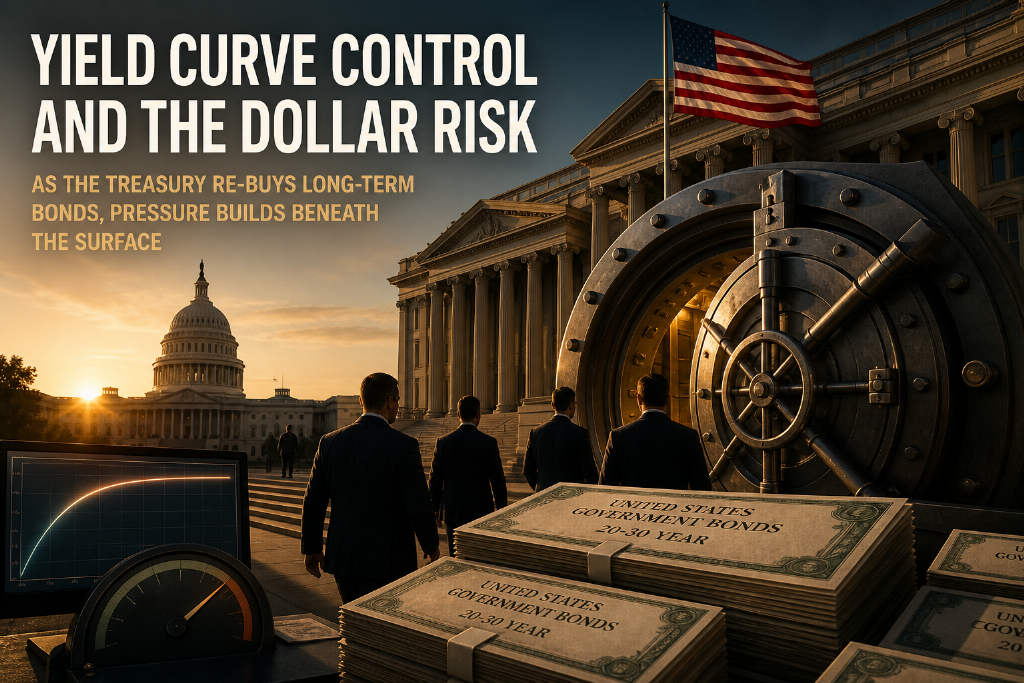
TS Lombard2026-08-20 13:10:52TS Lombard says U.S. long-bond buybacks resemble yield curve control and could pressure the dollarTS Lombard said the U.S. Treasury’s move to buy back ultra-long government bonds "sounds a lot like" yield curve control, arguing that efforts to hold yields down by intervention could weaken the U.S. dollar. In a report, chief economist Freya Beamish said the United States is running procyclical fiscal policy and, in her view, interest rates should be rising, a setup that would normally support the dollar. She said long-term bond investors want compensation, while the Treasury is intervening to suppress yields and further shorten debt duration even though the average maturity of debt is already relatively short. Beamish said the main question is how markets ultimately push back: by keeping pressure on long-end yields and forcing the Federal Reserve to act sooner than currently expected, or by selling the dollar instead. She added that the Fed will eventually raise rates.1090
Treasury yiel2026-08-19 09:51:2430-year Treasury yield hits 5.33% as backtest points to weak short-term but firmer 12-month S&P 500 returnsThe U.S. 30-year Treasury yield climbed to 5.33% on Aug. 18, its highest level since June 2007, while the 10-year yield approached 4.75%, also near the top of this year’s range. In a historical backtest built on public FRED data, BlockTempo examined how the S&P 500 performed after Treasury yields broke above their highest level of the prior 36 months. The results were mixed in the near term and much stronger over a one-year horizon. For the 10-year yield, there were 10 qualifying signals since 1985. The S&P 500 posted an average return of -1.1% three months later, with seven of the 10 cases ending lower, versus a full-period benchmark of +2.5%. Twelve months later, the average return improved to +11.8%, with nine gains out of 10, roughly in line with the +10.6% benchmark. The 30-year yield produced only six such signals since 1985, with July 2026 marked as the latest live sample. Across the five completed cases, the S&P 500 averaged 0.0% after three months and +10.8% after 12 months, with all five one-year outcomes positive. The report also said rising debt totals alone had little predictive power for equities, while the reason behind higher yields mattered more, especially when moves were driven by inflation or fiscal concerns rather than growth.1400